
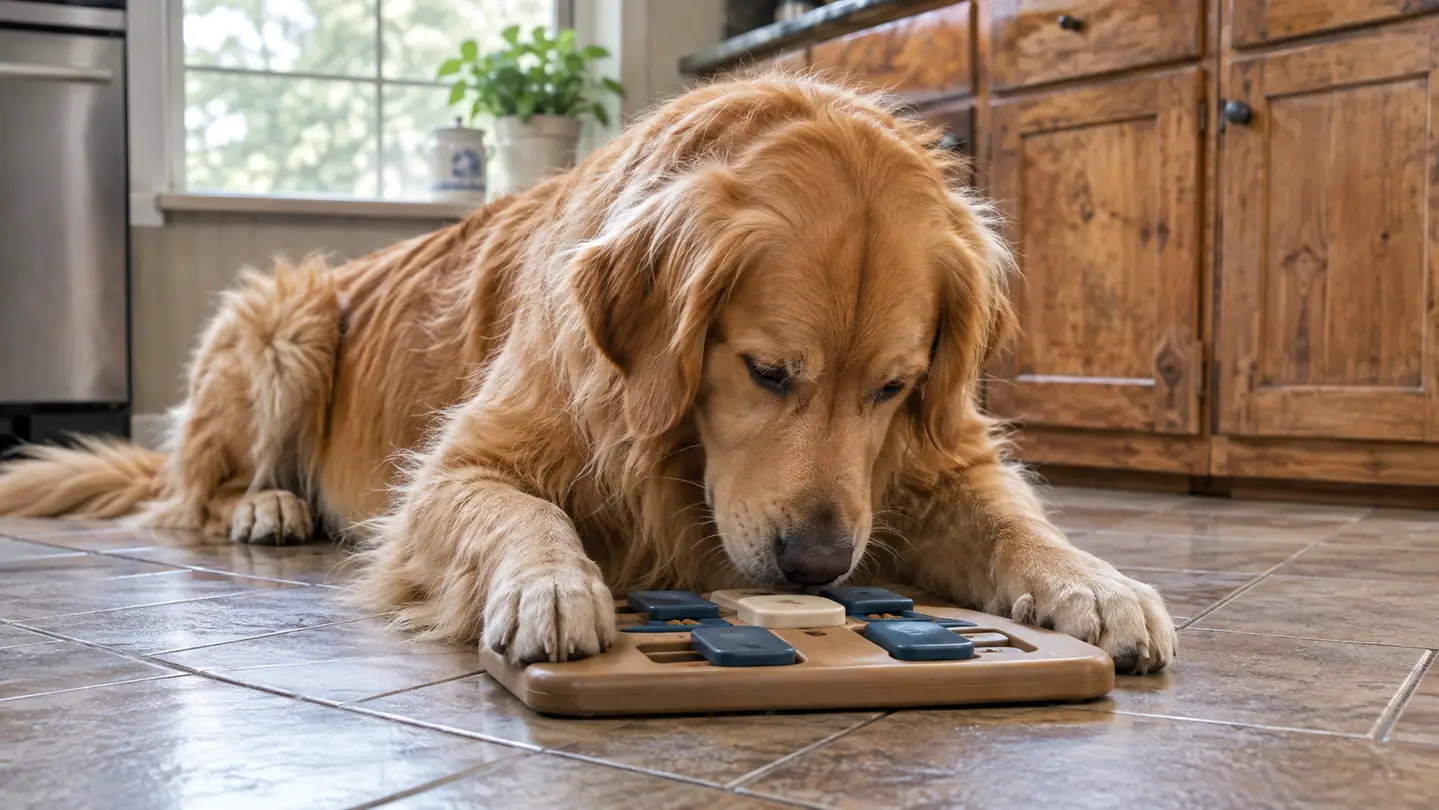
Rainy mornings in Tehachapi do not look dramatic. They look like three dogs standing in the kitchen at nine in the morning, staring at me, because the walk got cancelled and nobody explained the change of plan. Two years ago, on a morning exactly like that one, I set the Outward Hound Nina Ottosson Dog Brick down on the tile in front of Pepper and the house went quiet for about ten minutes.
Pepper is my cattle dog mix. She is six, she weighs forty two pounds, and she gets bored the way a pot boils, slowly and then all at once. She shreds anything flimsy, which is why most of what survives in this house is heavy rubber or nothing at all. The Brick is neither. It is a plastic puzzle, Level 2 intermediate, 12.75 inches long, 8.75 inches wide and 1.75 inches high, and it weighs a bit under nine ounces. What it bought me was not a calmer dog or a cured habit. It bought me ten minutes of a working brain on a day when the yard was too wet to use. Two years on I still reach for it, and I still put it away the moment we finish, and both of those facts belong in this review.
The Quick Verdict
Ten minutes of real thinking for a bored dog, in a plastic frame that has taken two years of weekly use without a crack. Supervised only, and it has to be, because the moving parts lose to a jaw every time.
Amazon Check Today's Price →The puzzle I still reach for on wet mornings
Level 2 intermediate, three different ways for a dog to hunt for kibble, and small enough to sit on a kitchen floor without taking over the room. Worth a look if your dog needs a job and you are willing to sit on the floor with her.
Amazon Check Today's Price on Amazon →How I've Used It
I look after other people's dogs in my own home, and I have done it for nine years. Most weeks there are two or three guest dogs here alongside Pepper, which means nothing gets tested in a quiet laboratory. It gets tested by a rotating cast of dogs who each have their own opinion about what a toy is for. The Outward Hound Brick comes out on rainy mornings, on the hot afternoons when the pavement would burn a foot, and on any morning when I can see Pepper is going to spend the day looking for a job to do on her own. That last one never ends well, so I head it off before it starts.
The rule here is one dog, one toy, separate spots. Food toys are always supervised, and no dog is left alone with anything. That is not a criticism of this puzzle, it is just how this house runs. The Brick in particular is plastic with parts that move, and moving parts are exactly what a hard chewer wants to take apart. So it lives on the top shelf of the hall closet and it comes out only when I am sitting on the floor next to it. If you are after something to drop in a crate on your way out the door, this is the wrong product and I would rather say so on the first screen than have you find out later.
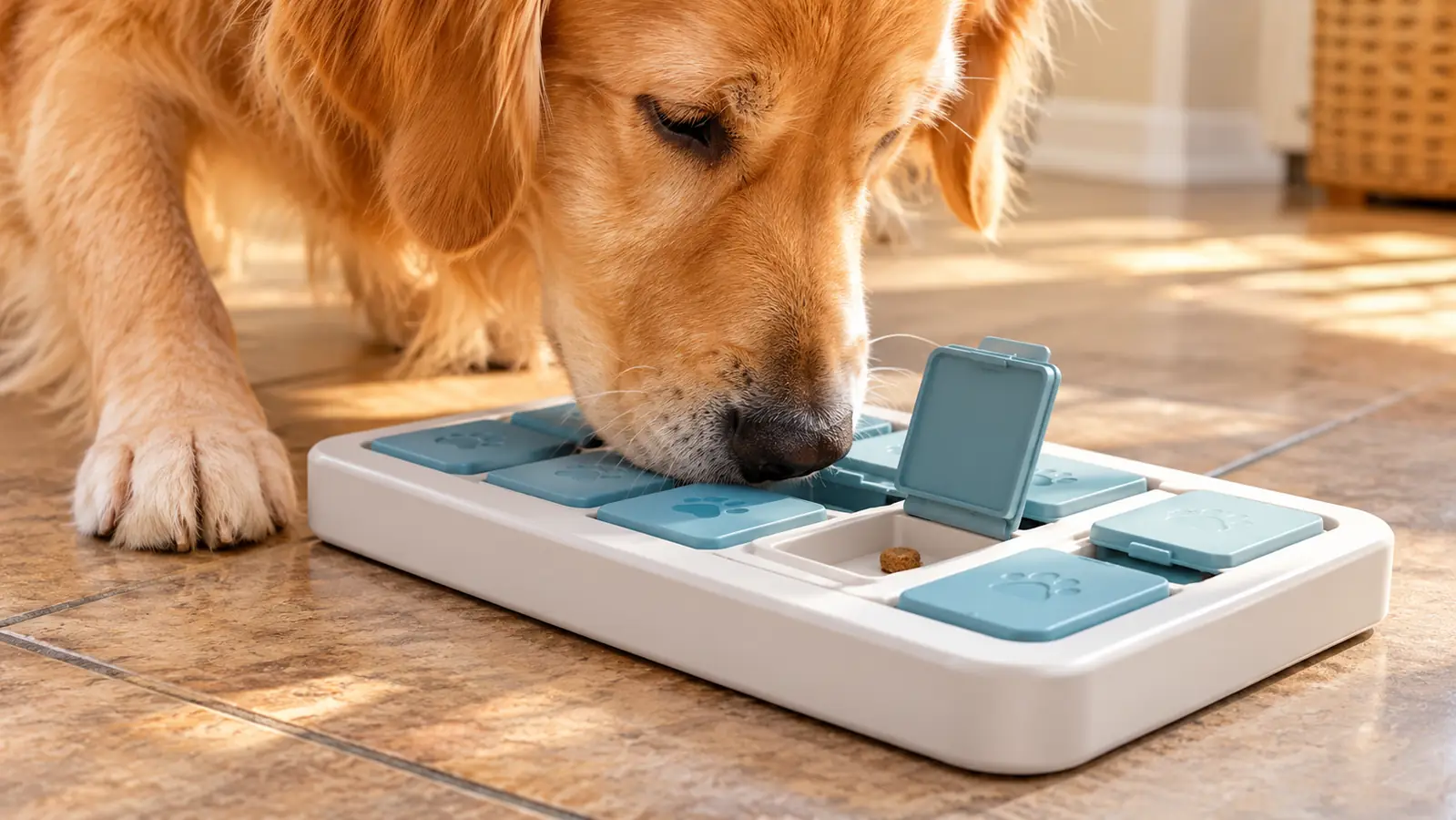
Filling it takes about a minute. I use plain kibble, because that is what the dogs already work for, and because a puzzle packed with something richer turns into a swallowing contest. The dog lifts the bone pieces out, flips the lids open and pushes the sliders across. Those are the three jobs. There is nothing electronic inside it. No timer, no app, no sound. It is a molded piece of plastic with parts that move, and the dog has to work out what order to move them in.
Pepper's first session took about ten minutes and most of that was her pawing at the thing like it owed her money. That is normal. A dog who has never worked a puzzle does not know that the point is under the lids, not inside the frame. My job in those first sessions was to sit still and let her be wrong for a while, which is harder than it sounds when you can see the answer from where you are sitting.
What the Puzzle Actually Asks a Dog to Do
There are three separate mechanisms on the Brick, and that is the reason it holds Pepper longer than a treat ball ever did. The bones sit in recesses and lift straight out. The lids flip open on a hinge. The sliders travel along a track across the top. Each one asks for a different motion, and the dog has to notice that the move that worked on one is not the move that works on the next. Most toys ask for a single motion, repeated until the food is gone. This one asks for a small piece of thinking, and the thinking is the part that wears her out.
The packaging talks about brain work being worth more than running. I cannot verify any of that and I am not going to pretend I can. What I can tell you is what I see. Pepper can run a fenced yard for half an hour and come back in ready for more. She works the Brick for ten minutes and then lies down on the tile with her chin on her paws. Whatever the exchange rate is between thinking and running, ten minutes of puzzle buys me more rest than twenty minutes of chewing does.
By year two she still gets up and walks away when the kibble is gone, but she no longer walks away in the first minute. She has also stopped doing the thing she did in week one, which was to take the edge of the whole frame in her mouth, lift it and drop it. The puzzle is light, and a determined dog can get a corner up off the floor. Tile makes that easier for her. If your dog's first instinct with any new object is to pick it up and shake it, plan on keeping a hand on the frame for the first few sessions until the sniffing takes over.
The Two Weeks It Took Pepper to Stop Pawing at It
I keep a note on the fridge for each dog that stays here, mostly so I remember which one needs the slow feeder and which one cannot be trusted anywhere near the compost. Pepper's note says three sessions to stop pawing at the Brick, and about two weeks to solve it quickly. Three sessions is fast by the standard of the guest dogs. Two weeks is about average. A guest beagle who stayed last spring sniffed one lid, looked at me, and went to sleep on the porch. That is not a failure of the toy. That is a dog who does not enjoy that kind of work, and there are plenty of them around.
The pattern I see over and over goes like this. Session one, the dog is confused, mildly frustrated, and may try to chew a corner. Session two, the dog remembers that something good happened here and tries harder. Session three or four, a piece of kibble comes loose by accident and the whole thing clicks into place. After that it is a race. Some dogs stay at the racing stage forever, which is why I keep using it. Some dogs solve it in four minutes flat and are ready for something harder. If your dog lands in that second group, treat a Level 2 puzzle as a starting point rather than a destination.
Here is the part that surprised me. The Brick does not stop being useful once the dog is good at it. It stops being a challenge and becomes a routine, the same way the morning walk stops being exciting and still gets done. On a wet day, a routine that takes ten minutes and uses the dog's head is worth keeping on the shelf. I expected this to be a phase. I did not expect to still be filling it in year two.
Where It Lives, and Why It Is Not a Chew Toy
The Outward Hound puzzle lives on the top shelf of the hall closet, behind the spare leashes. That is not tidiness. That is a decision. The parts that move are thin plastic, and thin plastic loses to a determined jaw every single time. Pepper is a hard chewer who has destroyed things a good deal sturdier than this. The only reason the Brick is still whole is that she has never once been left alone with it. Two years of use and I cannot find a tooth mark on it anywhere.
Cleaning is a damp cloth and thirty seconds. The listing says it is not water resistant and that is accurate, so I do not hold it under the tap and I do not put it in the dishwasher. I wipe it out, let it air dry on the counter and put it back. Kibble dust collects in the slider tracks after a while and a fingernail gets it out. That is the entire maintenance routine and it has not changed in two years.
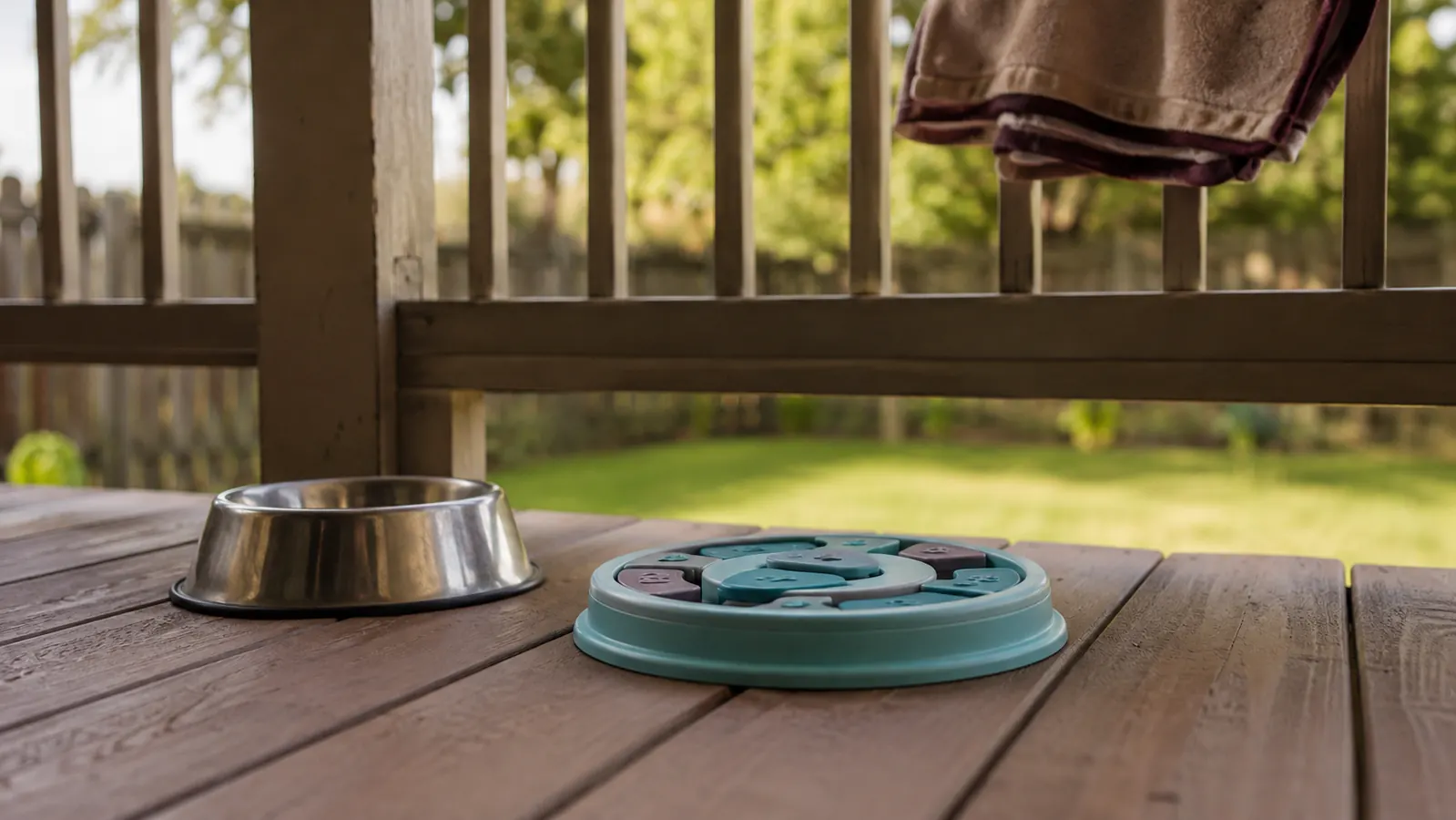
Size is worth thinking about before you buy. At 12.75 inches by 8.75 inches it takes up real floor space, which matters in a kitchen like mine where three dogs are already underfoot. It is light and portable, and I do move it, because a puzzle that appears in the same spot every day stops being interesting after a week. It goes out onto the covered back porch when the weather is decent. It stays on the tile when the weather is not.
Two Years In: What Held Up
Two years is long enough to know what a thing is. The plastic has not cracked. The lids still flip and the hinges are still tight, which surprised me, because hinges on anything are usually the first thing to go. The slider tracks have not developed a wobble. The only wear I can point to is a faint scuff on the underside from being slid across tile. I cannot tell you it will last ten years, because I have only had it for two, and I would rather give you the number I actually have than the one that sounds better.
I bought two puzzles the same month, two years back, and only one of them is still in this house. The other was an Outward Hound Dog Tornado. Pepper got a grip on a layer, flipped it and chewed the edge before I had crossed the kitchen. I gave it away that month. That was as much my fault as the toy's, since I had turned my back, but it set the rule I use now. The puzzle comes out when I sit down and it goes away when I stand up. The Brick is the one that fits that rule. Even when Pepper gets a corner of it up off the floor, the pieces stay seated instead of coming away in her mouth.
What has not held up is my patience for the filling routine on a morning when I am already running late. Ten minutes of dog work means one minute of my work first, and on a bad morning that minute feels long. That is the honest downside. A chew toy you hand over. A puzzle you set up, sit with, and take away again. Two years in I still think the trade is worth it, but I would not pretend it comes free.
And for anyone wondering whether the puzzle replaced anything here, it did not. Pepper still gets both walks. She still gets her evening chew at seven, and that is a heavy rubber toy, not this. The Brick does one job, which is to give a bored dog something to think about on a day when the yard is out of reach. It does that job well. It does not do any other job, and I think that is the right way to buy one of these.
What I Liked
- Three different mechanisms, so a dog has to think instead of just nosing at it
- Two years of weekly use with no cracks, no loose hinges and no wobble in the sliders
- Wipes clean with a damp cloth in about thirty seconds
- Light and portable, so it moves around the house instead of becoming furniture
- Works with plain kibble, which keeps a dog from gulping her food
Where It Falls Short
- Not a chew toy, and never to be left with a dog alone
- Light plastic, so a determined dog can get a corner up off the floor
- Not water resistant, so no soaking and no dishwasher
- Takes up real floor space in a small kitchen
- A clever dog will solve it fast and be ready for something harder within a couple of weeks
Two years of use and I cannot find a tooth mark on it anywhere. That is not because Pepper is gentle. It is because the Brick has never once been left alone with her.
Who This Is For
This is for the owner of a dog who needs a job. If your dog follows you from room to room at seven in the evening, or stands in the kitchen staring at the cupboard where the treats live, or finds something to shred the moment the walk is over, a puzzle is a sensible next purchase. It suits a smart dog who has already beaten every treat ball in the house. It suits a wet winter, a hot summer, or a stretch where the dog's activity has to be limited for a while and the head still needs somewhere to go. And it suits people who are willing to sit on the floor for ten minutes. That is the real requirement, and it is not a small one.
Who Should Skip It
Skip it if your dog's first move with any new object is to carry it to the rug and chew it, because the Brick will not survive that, and a chewed-up puzzle is a swallowed plastic risk I am not comfortable with in my own house. Skip it if you want something to leave in a crate or hand over on your way out. Skip it if your dog has already solved several Level 2 puzzles, because the challenge will be over inside a week and you will be shopping again. And skip it if you want the puzzle to do the work on its own. A dog left to figure it out with nobody nearby will often just give up, and then you have a piece of plastic on the floor. The sitting down part is the product.
A wet morning puzzle that has earned its shelf space
Level 2 intermediate, three ways for a dog to hunt, light enough to carry from room to room. Supervised use only, and worth it if you will sit on the floor while she works.
Amazon Check Today's Price on Amazon →