
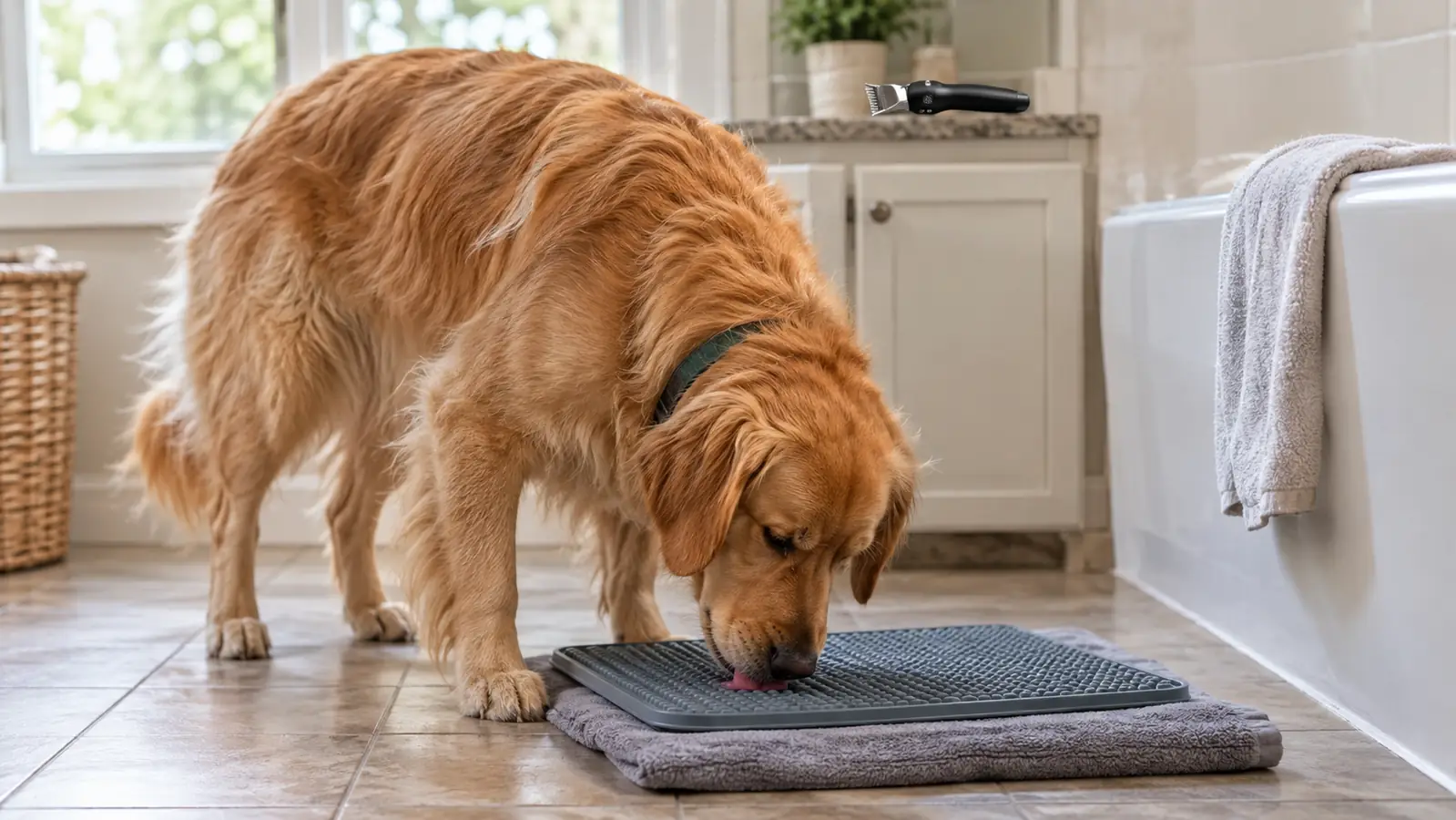
My cattle dog mix, Pepper, does not mind water. She minds the nail grinder. For two years I paid a groomer to do a job I could have done at home in ten minutes, because the two of us wrestling 42 pounds of dog on a tile floor was worse for both of us than the drive across town. Baths were their own small fight, mostly because she spent the whole time trying to climb out of the tub. What changed it was not a better brush and not a calmer handling technique. It was a flat rubber mat with a bumpy surface that I smeared with plain yogurt. The first time I set a LICKIMAT Classic Soother on the floor beside the tub, Pepper put her head down and licked, and forgot to brace her legs. That was three years ago, and it is still the setup I use here, for my own dog and for the guest dogs that come through this house.
I am not going to tell you a lick mat fixes how a dog feels about nail trims. It does not, and anyone who says so is selling something. What it does is give the dog a job for its mouth and its attention while you do a short, boring piece of work on its feet. That is the entire mechanism as far as I can see it. A dog licking at a textured surface has its head down and its feet planted. Planted feet are what you need for thirty seconds at a time. I learned this by doing it badly for a season, and what follows is what I would hand a neighbour who asked me over the fence.
The eight inch rubber mat I keep two of, for exactly this job
The LICKIMAT Classic Soother is the flat mat in every step below. No suction cup to pull off and chew, top rack of the dishwasher, and a textured surface that holds a thin smear of yogurt for about ten minutes.
Amazon Check today's price on Amazon →Step 1: Put the mat down before the dog knows anything is happening
Dogs read sequences, and they read them better than we give them credit for. If the clippers come out first, then the towel, then the mat, the mat never gets a chance. Pepper can hear the drawer with the grinder in it from the next room and she is under the kitchen table before the second sound. So the order of the setup matters more than anything else in this article.
What I do now: the mat goes down on a folded towel on the tile before anything else comes out of a drawer. The filling is already spread. Then I go and get the dog, or better, I let her wander in and find it herself. She puts her head down. I sit on the floor beside her rather than standing over her, and I start. By the time she has thought about standing up, there is food in front of her and she has decided the floor is a reasonable place to be.
This works on a nervous guest dog too, and not for nails. For the first evening. A dog that has just been dropped off in a strange house and is pacing the hallway will often stop pacing if there is a mat with something on it in a quiet corner. I set one down, sit nearby with a book, and let the dog come to it in its own time. Half of them are at it within five minutes. The other half need a night to settle before they will try, and that is not a failure of the mat.
Step 2: Pick a filling that outlasts the job
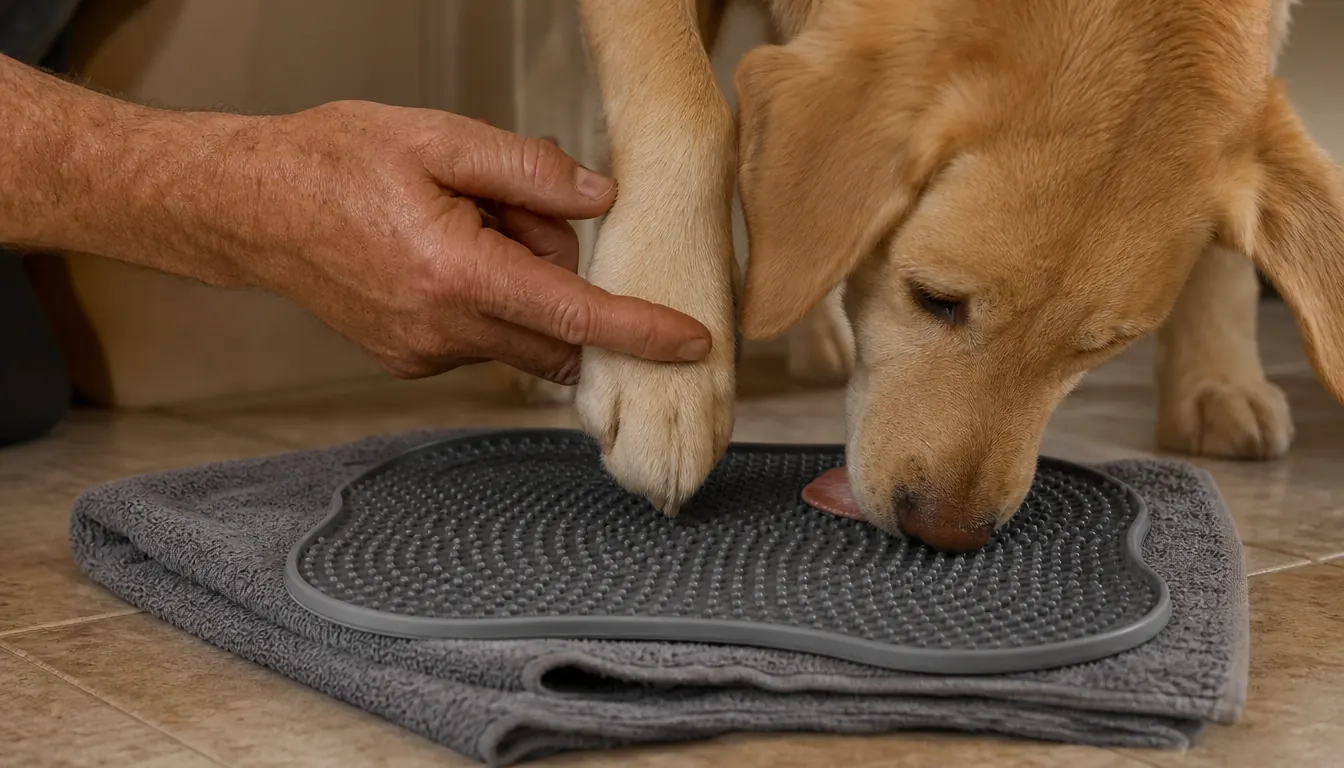
A thin smear is the whole point. If you pile it on, the dog takes it in two or three swipes and you are back where you started with a dog who now expects a second helping. Spread it thin enough that the tongue has to work at the texture. A thin layer of plain yogurt or canned pumpkin runs about ten minutes on my mat. Frozen flat, it runs closer to twenty, which is useful on a day when the job is going to take longer than usual.
What goes on mine: plain yogurt, canned pumpkin, a little kibble pressed into the surface, or peanut butter with no xylitol in it. Read that label. Xylitol turns up in more peanut butter than people expect and it is not a thing to guess at. I keep it to one or two ingredients, because rich food right before a nail trim is a bad idea for a dog with a sensitive stomach, and a dog that feels off is not a dog that stands still for you.
The texture does the work. The LICKIMAT Classic has a shallow raised pattern on it, the Soother surface, so food sits in the gaps instead of sliding around on top. That is the difference between this and a dinner plate with a smear on it. A dog clears a plate in one pass. This takes actual licking, which is the part that keeps the head down and the feet planted.
Step 3: Give it something that will not slide
The Classic is a flat mat with no suction on it. It is about eight inches square and light enough that a determined dog can push it across the tile. On my kitchen floor it walks. On a folded towel it stays put, because the towel grips the tile and the rubber grips the towel. That is the whole fix and it costs nothing.
I tried the other kind first. Three years ago I bought a silicone mat with suction cups and stuck it to the wall of the tub, thinking bath time would be easier with the dog licking at eye level while I washed her. Pepper had it off the wall inside the first week and chewed the cup off the back. That mat went in the bin the same week. If you have a dog who grabs at things, a suction cup is a handle, not a feature.
One dog, one mat, one spot. That is the rule here for any food toy, and it applies double when two dogs are in the house. Two dogs on one mat is a guarding problem waiting to happen, and I have never once seen dogs share nicely under those conditions. A guest dog gets its own towel and its own corner, out of sight of the others, and I stand where I can see both.
Step 4: Work in short passes and stop before the food runs out
You are not doing all four feet in one go. You are doing one paw, maybe two nails, and then stopping to let the dog lick. Then another two. The mat is the clock. When the food is gone the session is over, and that is the right way for it to end, because it ends with the dog still wanting more instead of with the dog walking off.
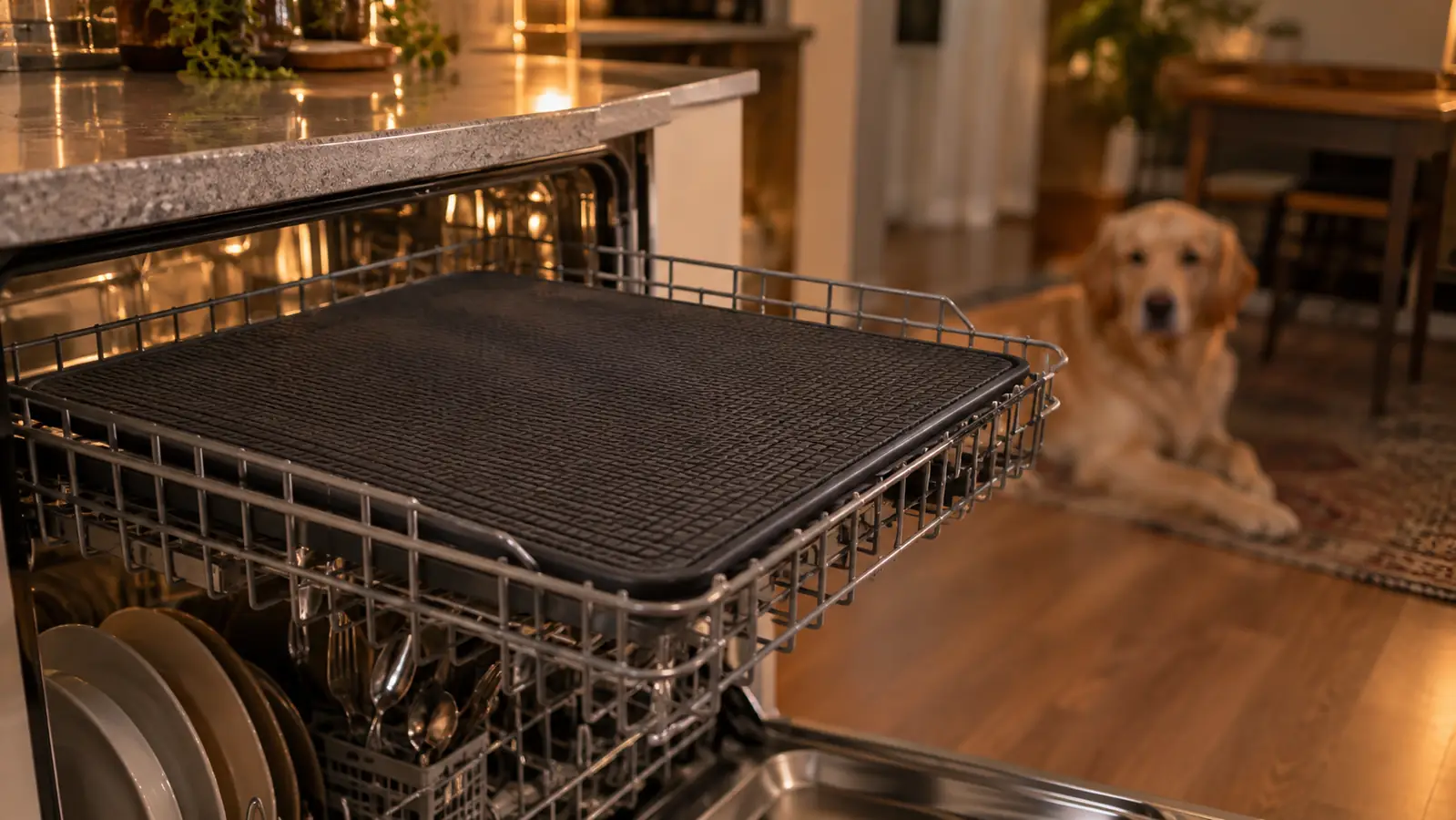
I own two mats for exactly this reason. One goes down while the other is in the dishwasher, and on a rough day I can put a second thin smear out and buy another five minutes. The second mat is not a reward for the dog. It is a reward for me, so that I am not rushing the last nail because the yogurt ran out.
Bath time runs the same way. The mat goes on the towel at the end of the tub, on the floor, never in the water. I wet the dog down, wash one end, rinse, and let her come back to the mat for a minute. Pepper is short coated so her bath is quick, but a thick coated guest dog takes me twenty minutes and gets two or three stops at the mat in that time. The stopping is what keeps a bath from turning into a chase around the bathroom.
One more thing on this. You do not need a second person, which was the whole reason I started looking at any of it. My hands are on the paw and the clippers, and the dog's attention is on the mat. For two years I assumed nail trims were a two person job because that is how the groomer did it. They are not. They are a ten minute job with a mat and a smear of yogurt, done sitting on the floor.
Step 5: Wash it and put it up the moment it is empty
The mat is dishwasher safe and mine rides the top rack. That is the main reason it is still in use three years on. Anything in this house that takes twenty minutes to clean stops getting used, no matter how well it works. Between washes it gets a rinse and a wipe if it has only had yogurt on it.
The second half of this step is that the mat comes up as soon as it is empty. It is not a chew toy and it is not meant to be left down. A guest puppy left one small chew mark on the corner of one mat, and that was my fault for walking away from it rather than the puppy's. Nothing since, because the mat now leaves the floor the second the food is gone. I store mine flat on a shelf with the towels, not folded, because a mat stored folded can split along the crease over time.
If you have a dishwasher you already have the easiest version of this job. If you do not, warm water and a brush take about a minute, and the shallow pattern rinses out cleanly as long as you get to it before the food dries on. I have never had to scrub mine.
What Else Helps
Two things made more difference than I expected. A second towel on the floor, so that if the dog pushes the mat there is something under it. And a warm room. A wet dog in a cold bathroom wants the session finished, and a dog that wants the session finished is not going to stand still, mat or no mat.
A rubber curry brush in the tub speeds up the wash, which matters more on a coated dog than the rest of this put together. Short sessions beat better tools every time. If your dog is genuinely frightened of the clippers, and I mean shut down and shaking rather than just wriggly, that is a conversation with your vet and not a shopping problem. I am not qualified to tell you otherwise.
It helps if the mat is part of the routine and not part of the event. In this house it comes out for nails, for baths, and for a nervous guest's first night. It does not come out for anything else. That is a small distinction, but dogs are pattern animals and I think it matters more than people assume.
And none of this replaced anything. I still walk Pepper twice a day. She still gets her chew in the evening. A mat did not make my dog a different dog. It made one specific job, on one specific floor, easier for both of us, and after nine years of other people's dogs in this house I will take that trade every time.
When the food is gone the session is over. Ending with the dog still wanting more beats ending with the dog walking off.
Set one down before the clippers come out, not after
Two LICKIMAT Classics, one in the dishwasher and one on a towel by the tub. That is the whole system that got my dog through nail trims without a second pair of hands.
Amazon Check today's price on Amazon →