
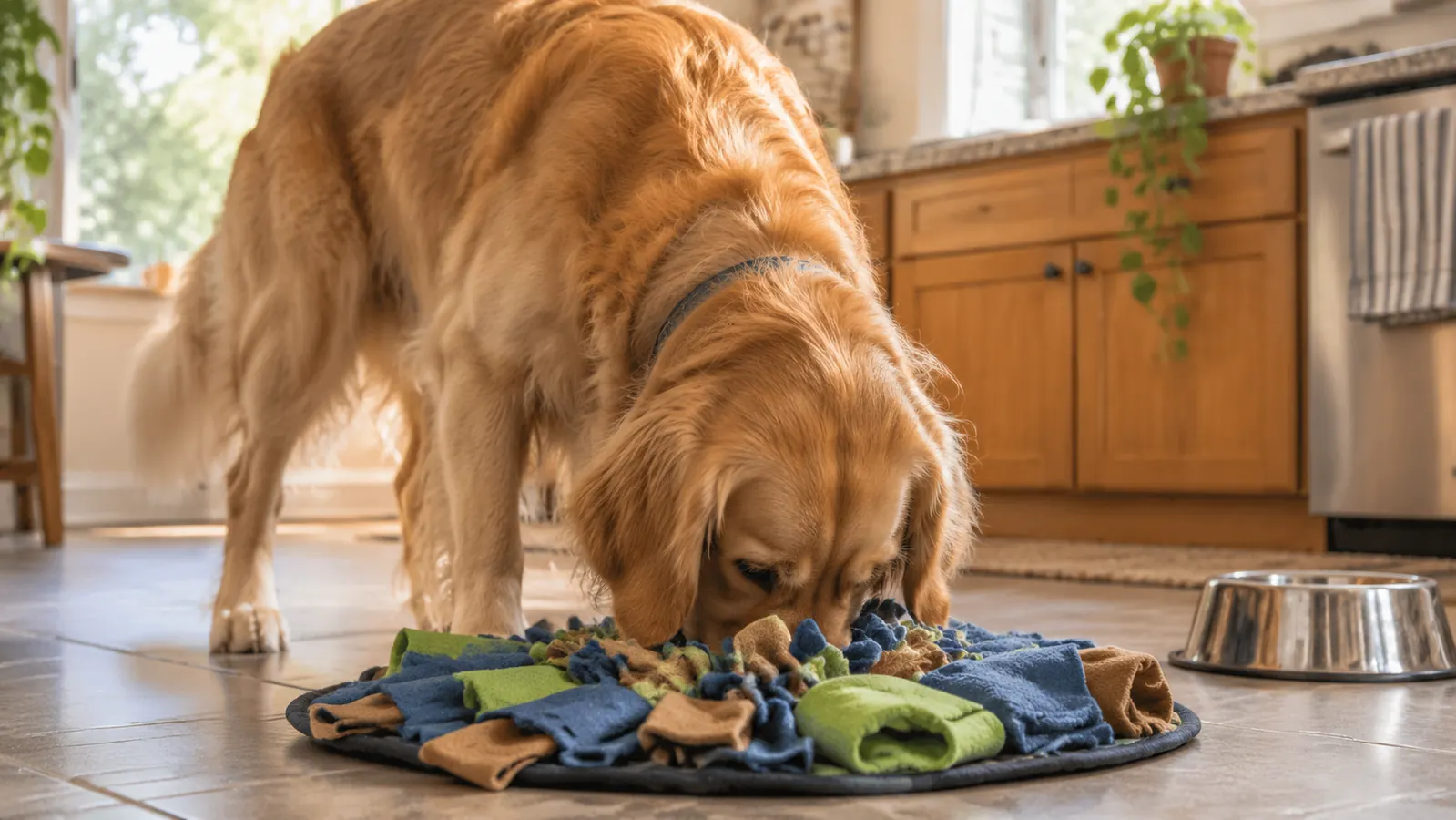
Pepper can empty a full bowl of kibble in 52 seconds. I know the number because I stood in the kitchen one morning with one eye on the microwave clock and timed her. Then she licked her lips, looked up at me, and acted like the meal had never happened at all.
A dog that eats that fast does not get much out of a meal. There is no sniffing, no sorting, no working for anything, and then nothing to do until five o'clock. Mine would finish breakfast and go stand at the back door, waiting for the day to start.
I tried a slow feeder bowl first and kept Pepper on it for two years. She solved the maze in about a week, then started pushing the bowl across the tile because the sliding was more interesting than the food. It went out to the garage 18 months ago and has not come back in.
What did slow her down was a snuffle mat. The AWOOF snuffle mat has been in my kitchen for 18 months, and breakfast now takes about 10 minutes instead of under one. It is not a complicated piece of equipment, but there are a few things I got wrong at the start, so here is the whole routine in the order I actually do it.
Ten minutes of breakfast instead of fifty two seconds
The AWOOF snuffle mat is felt cloth, about 18 inches across, folds into a bowl, and weighs next to nothing. You scatter the measured meal into the strips and the dog has to use its nose to get it back out. Supervised use, and it is not a chew toy.
Amazon Check Today's Price on Amazon →Step 1: Measure the meal, then scatter it into the strips
Use the food the dog was already going to eat. I scoop Pepper's normal breakfast into a cup, carry it to the mat, and scatter it across the cloth in small handfuls. Nothing extra goes on top. The whole point is a meal that takes longer, not a dog that eats more, and it is very easy to turn one breakfast into two without noticing you have done it.
Guest dogs get the same treatment, measured the way their owner measures it. A young lab staying the week gets his own scoop and his own mat in his own corner of the kitchen. Scattering a full meal takes me about 60 seconds, which is the only part of this routine that costs me anything at all.
If your dog stands there looking confused the first time, drop a few pieces on the floor beside the mat so the nose finds a trail in. That is how I started a nervous guest dog, and she was working the cloth inside a minute. A dog that has only ever eaten from a bowl does not automatically know that cloth can hold food. The first time I skipped this, a terrier mix sat down and stared at me for a solid three minutes while the kibble just sat there going stale, and I ended up putting half of it back in her bowl so she would eat at all.
Step 2: Work the kibble down into the fabric, not on top of it
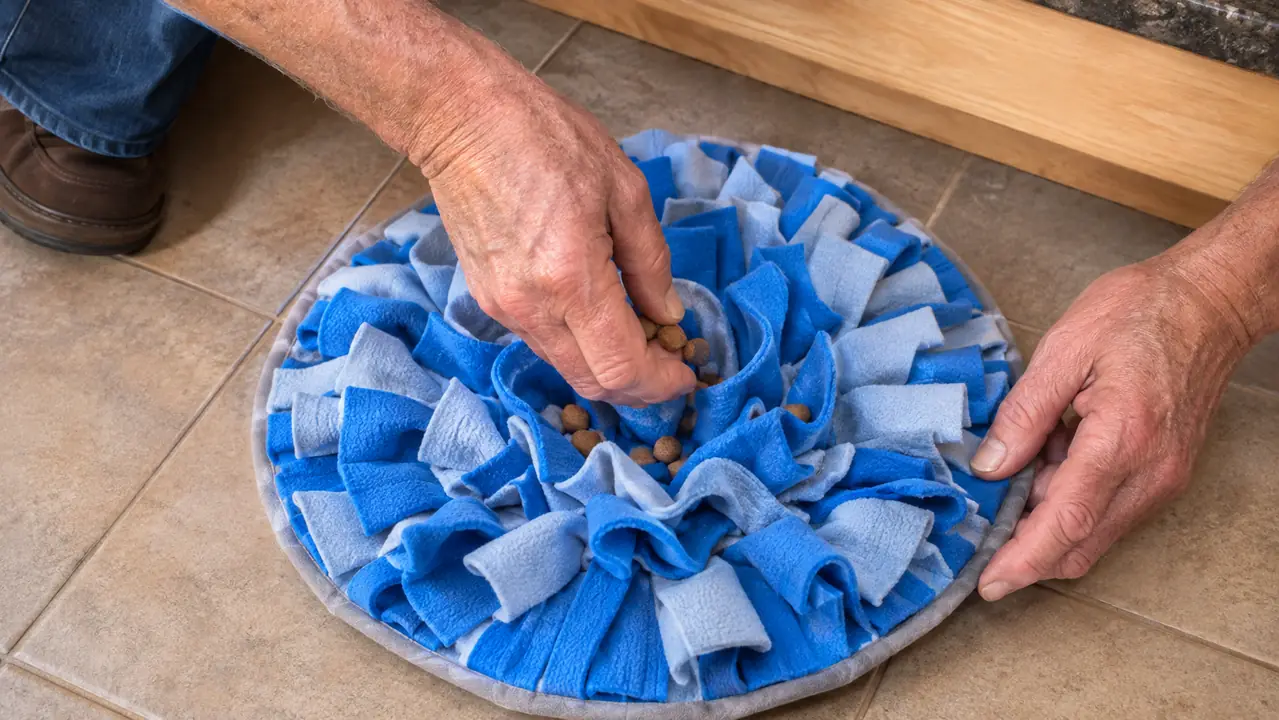
The mat is felt cloth with a whole field of strips, and the food has to sit down among them. If you dump the scoop on top and walk away, a fast eater will hoover it off in about the same 30 seconds as a bowl and you have bought yourself nothing. Take each handful and rub it down into the strips with your fingers.
Smaller kibble falls deeper and takes longer to get out. Big pieces sit up high and come out almost immediately. If you have a choice between two bags, the smaller kibble is the better one for this job. I also press the strips back down after loading, which hides the food a little better than leaving them all standing up. On the mornings I am rushing and only press half of it down, I can watch the difference in the clock: that version is gone in about six minutes instead of ten.
The mat is about 18.8 inches square and weighs under 5 ounces, so it does not feel like equipment. It sits on my tile floor like a small rug and it lives in the same spot every morning. That is the whole object. Cloth, strips, and food worked down into them. I checked the size against Pepper before I bought it, because she is 42 pounds and a small mat would have had her nose on the tile more than on the cloth. At 18.8 inches across there is room for her whole head with a bit to spare.
Step 3: Put it on a hard floor and stay in the room
The bottom of the AWOOF mat is a non-slip cloth and it does hold on my kitchen tile. That does not mean I leave the room, though. Food toys in this house are always supervised and the snuffle mat is no exception. I set it down, and I am in the kitchen while the dog works, usually with my back against the counter and a cup of coffee.
One dog, one mat, separate spots. If I have two dogs eating at once, one is at one end of the kitchen and the other is down by the back door. A guest beagle who eats like a vacuum gets his mat in the hallway with the door mostly closed, because he will absolutely go push Pepper off hers the second he finishes. Someone asked me why not just put two mats down side by side, and the answer is that I watched a beagle do it in October and it took him four seconds to abandon his own food and go for a better mat.
If your dog guards food, do not run two at once at all. One dog eats, the mat comes up, then the next dog eats. I have done it that way for years with dogs I do not know well, and it is not worth the argument to save four minutes.
Breakfast went from 52 seconds to about 10 minutes. That is the entire change, and it has held for 18 months.
Step 4: Fold it into a bowl for the first few tries
The mat folds up into a bowl shape, and that is the version I used for the first week with a guest dog who had never seen one. A bowl full of cloth strips is familiar enough that a dog will put its nose in it. A flat mat on the floor is not always that obvious to a dog that has only ever eaten out of ceramic.
Fold it, drop the kibble in, and let the dog work out that the food is down in the cloth. Once they are doing that reliably, open it back up flat again. Pepper never needed the bowl shape, but she is a cattle dog mix who investigates everything in reach, so she is not a fair test of that step. The seven-year-old pug who stayed with me in the spring was the opposite: he would not touch the flat mat at all, but folded into a bowl he ate out of it the first try.
The fold is also why it travels. The whole mat weighs about 5 ounces and folds small enough to go in a bag, which is more than I can say for the slow feeder bowl it replaced. I take it when I drive down to my sister's, and Pepper eats breakfast in a strange kitchen without any drama.
Step 5: Shake it out after every meal, and wash it weekly
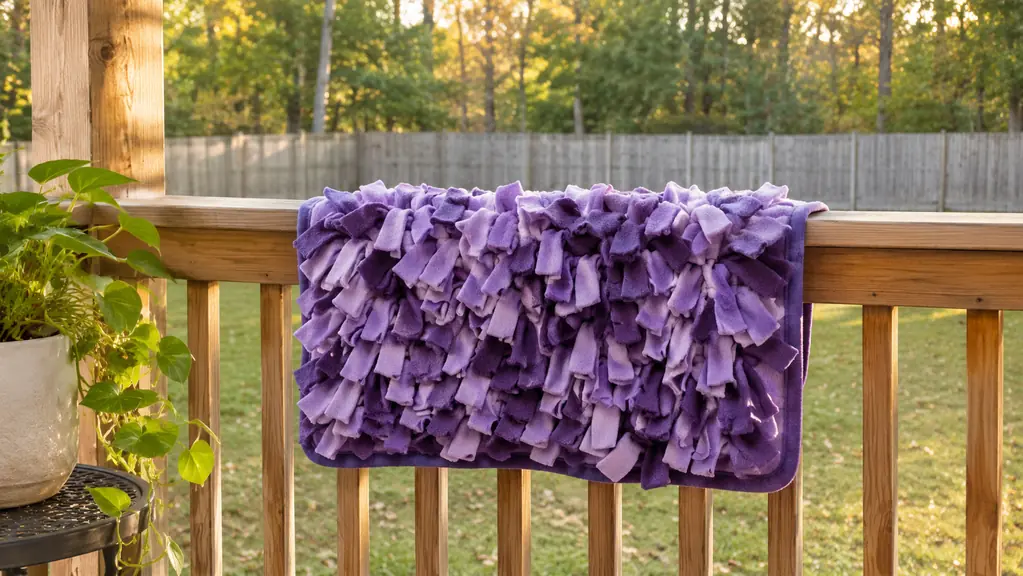
The mat is felt cloth and it is not water resistant, so it holds crumbs and it holds smell. After every meal I carry it out to the covered porch and shake it hard, then hang it over the porch rail until the next feeding. Once a week it gets a hand wash in the sink and air dries over that same rail. In the summer it dries in about two hours on that rail. In January it takes most of a day, so I wash it on a Sunday morning and use a spare bowl for Monday breakfast if it is still damp.
The other half of this step is putting it away. It is a feeding mat, not a chew toy, and the fabric strips will come loose if a dog decides to work on them. Pepper pulled one strip free in month two. Nothing dramatic came of it, but it told me what I needed to know, and now the mat is picked up the moment the kibble is gone.
That is the routine, start to finish. Down, loaded, supervised, shaken, hung, put away. The whole thing adds maybe two minutes of my time to a meal I was going to serve anyway.
What Else Helps
A snuffle mat slows down one meal. It does not replace a walk, and it does not fix a dog that is bored for the other twenty three hours of the day. Pepper still gets both walks, mid morning and late afternoon, rain or shine. She still chews, and she still needs to be taught things. Nothing on my shelf changed any of that.
The other thing in my kitchen that does this job is a frozen West Paw Toppl, filled with kibble and plain yogurt and left in the freezer overnight. That is the afternoon treat on the porch and it buys me about 25 minutes. The AWOOF snuffle mat is breakfast. Different jobs, different parts of the day, and I would not want to give up either one.
If you would rather stay with a bowl, a slow feeder is not a bad choice. It is simple, it holds a full meal, and plenty of dogs never solve them. Pepper did solve hers, and once she was pushing it around the tile for entertainment, it had stopped doing the job it was bought for. That is the honest version of why it went to the garage.
Feeding in a quiet spot helps too. A dog that is watching the back door while it eats will bolt the food and then go check the door. I feed Pepper in the kitchen with nobody moving through, and the mat gives her a reason to keep her head down instead of watching the room.
One last thing, and it is the one people skip. If you split the day's food across a couple of these instead of one big bowl, the dog gets more of the day covered. Pepper gets the mat at seven and a chew at seven in the evening, and both of those are working time rather than waiting time.
The easiest ten minutes you can add to a dog's day
One AWOOF snuffle mat, one measured meal, and a dog that has to use its nose for its breakfast. Cloth, about 18 inches across, folds into a bowl, and picks up in one hand when the food is gone. Keep it up between meals and shake it out after every use.
Amazon Check Today's Price on Amazon →