
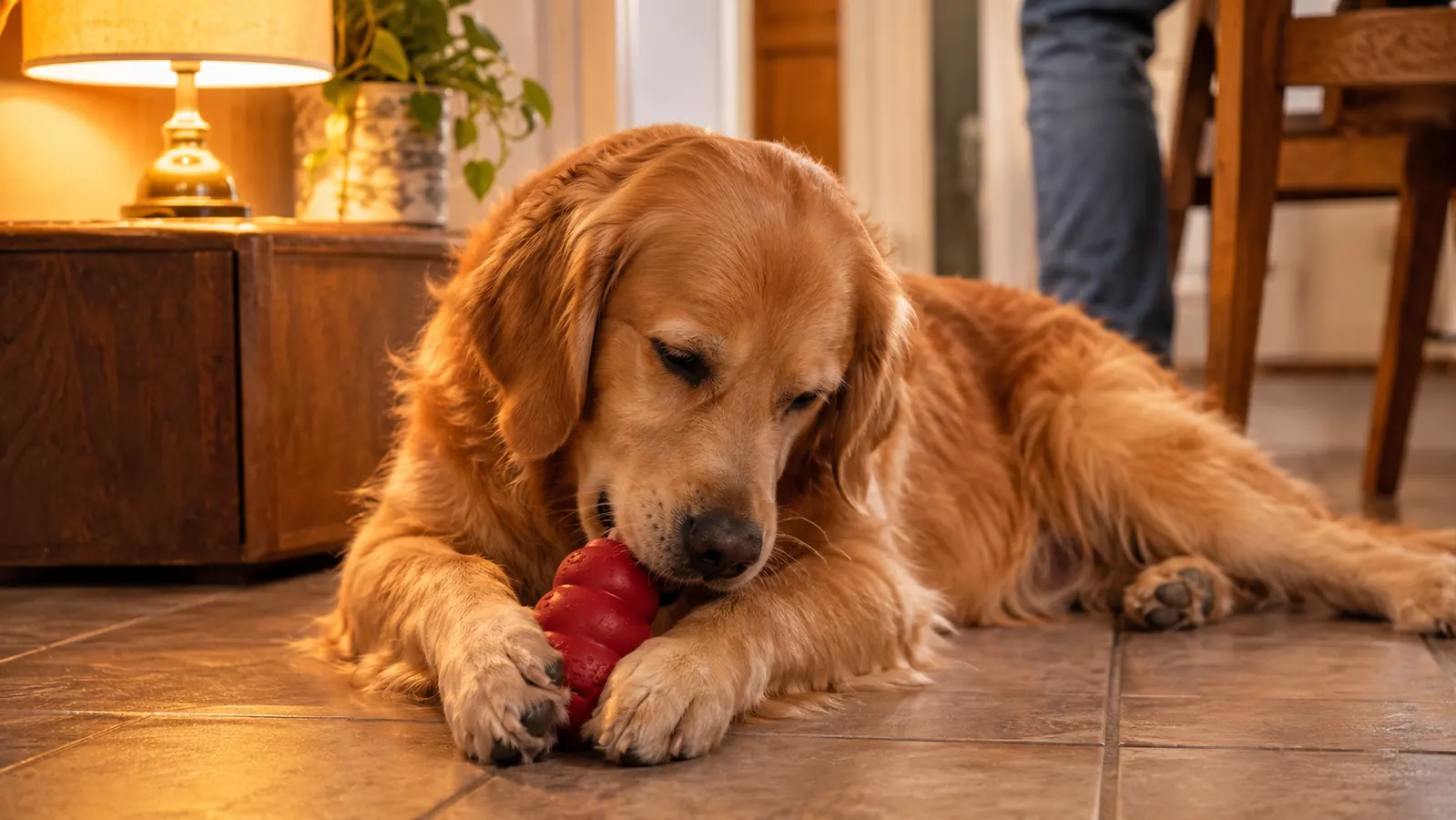
Pepper is six years old, forty two pounds, and a cattle dog mix, which means her brain stays busy even when her body is resting. She is also a hard chewer. She has taken apart things sold as tough, and she gets bored fast enough that a plain chew will not hold her for long. Four years ago I brought home a KONG Extreme in the large size, mostly out of frustration, and it is still in the house. I look after other people's dogs in my home in Tehachapi, usually two or three at a time, and the difference between an evening that runs smooth and one that does not usually comes down to whether every dog has something to do with its mouth.
Here is the thing I got wrong for years. I kept buying harder toys for a harder chewer, and I kept throwing them out. Rubber so dense it had no give, bones that wore into sharp little nubs, ropes that turned into a pile of thread. What Pepper needed was not a tougher object to destroy, it was a job that took twenty minutes and paid off in food. That is what the KONG Extreme does here. It is a hollow rubber chew, 7.76 ounces in the large size, and I stuff it with kibble and a smear of peanut butter. The toy is the container. The work is getting the food out.
The chew that is still in this house four years later
This is the one Pepper gets at seven in the evening. Large size, natural rubber, hollow inside for stuffing. It has outlasted everything else in the toy bin.
Amazon Check Today's Price on Amazon →The Five Steps I Take Every Evening
Step 1: Get the size and the material right first
Before fillings or timing, size. Pepper is forty two pounds and a serious chewer, so she has the large KONG Extreme, and it weighs 7.76 ounces in the hand, which tells you something about how much rubber is in it. The material is natural rubber, not the hard nylon that wears into sharp points. I had one of those for her once, a Nylabone Power Chew, and after five months the surface went rough and nubby in a way that made me nervous. It went out four years ago, before the KONG Extreme arrived, and the two were never used side by side.
I own three of the large KONG Extreme now. Not because one wears out, but because this house usually has two or three guest dogs and nobody shares. One dog, one toy, and the toys go back in the cupboard when the dogs are not being watched. If you have a single dog, one is enough to start, and you will probably want a second so one can dry at the sink while the other is in use.
One honest note on how it moves. It bounces in a way that is genuinely erratic, which the listing brags about and which is a nuisance on a tile kitchen floor. It has knocked into the baseboards here more than once. This is a chew and a stuffer in my house, not a fetch toy for indoors. Out in the yard, a young dog will chase that bounce for a while. In the kitchen at seven in the evening, it is something to know about ahead of time.
Step 2: Stuff it so getting the food out is actual work
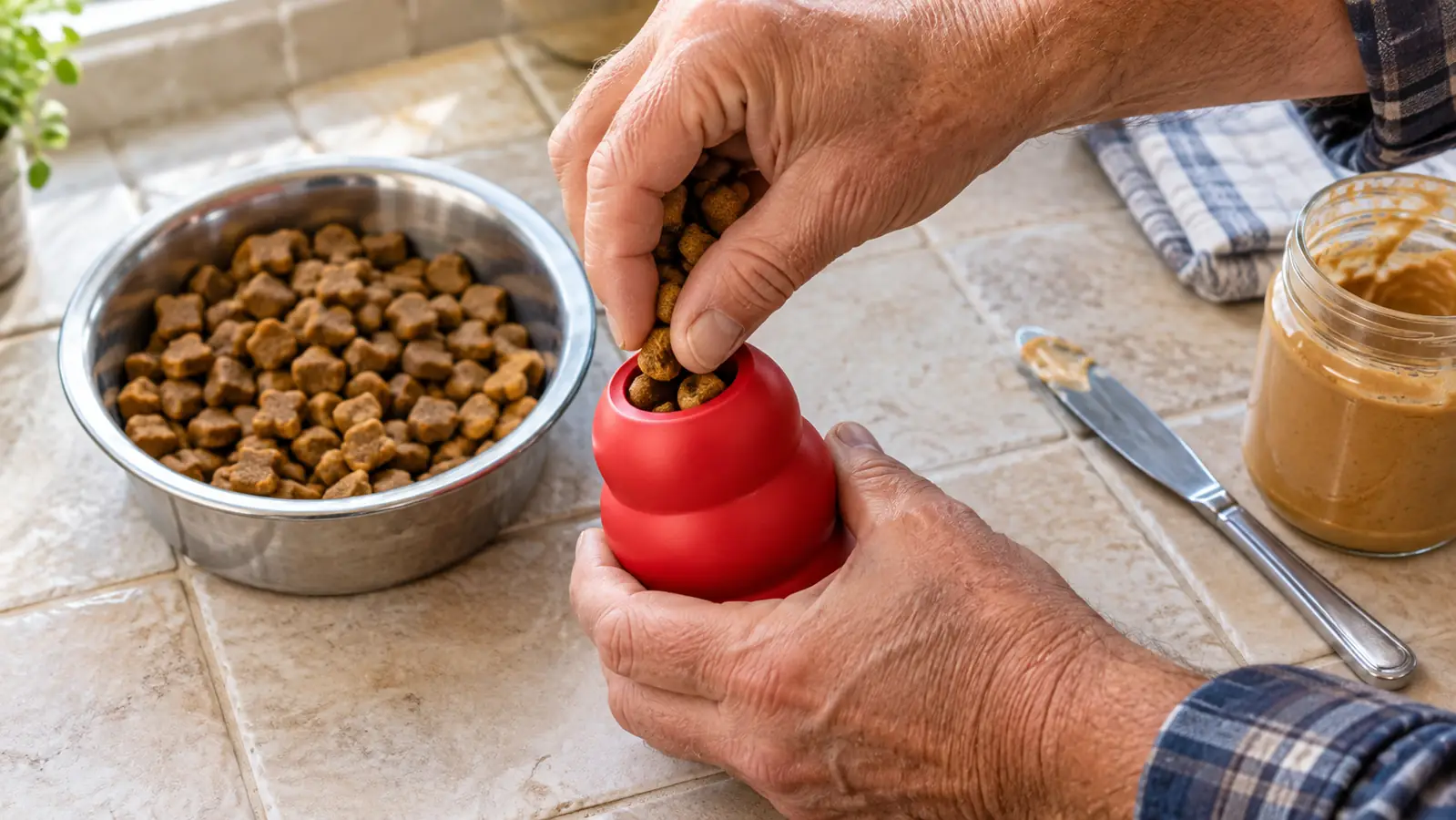
I fill the hollow interior with kibble first, then a thin smear of peanut butter with no xylitol in it around the top rim to get things started. Packing the kibble in tight with a thumb is the difference between a toy that lasts four minutes and one that lasts twenty. If I am organised, I pack two in the morning and put them in the freezer, and a frozen one buys closer to half an hour.
Safe fillings here are plain yogurt, canned pumpkin, kibble, and peanut butter that is checked for xylitol every single time. That is the whole list. Nothing with bones, nothing cooked, nothing with onion or garlic in it, and nothing small enough for a dog to choke on. If you are unsure about an ingredient, leave it out. Plain soaked kibble works fine and it is what I use most nights.
A stuffed chew is not a meal and I do not count it as one. Pepper eats at seven in the morning and five in the evening, and the seven o'clock chew is a small handful of kibble taken out of her daily ration rather than added on top of it. If your dog gains weight easily, take the kibble out of the bowl rather than adding it. Small detail, but it matters over years.
Step 3: Same time, same place, one dog per toy
The KONG Extreme comes out at seven in the evening. Not when Pepper is being a pest, not as a reward for anything, just at seven, most nights. She now starts watching me around ten to seven. That predictability is doing as much work as the food is, because she knows the dull stretch of the evening has a beginning.
The first week looked nothing like this. Pepper pawed at it, rolled it, and looked at me as though I had handed her a rock. What got her started was a little peanut butter right at the opening where she could reach it without solving anything. Once she understood there was food inside, the pawing turned into working. If your dog gives up, make the first few sessions easier rather than harder and let the difficulty build back over a week or two.
Where the dogs chew is separate and stays separate. Pepper gets the rug beside my chair. Each guest dog gets its own spot, a bed or a corner, and I sit where I can see all of them. No dog is left alone with a toy in this house, and no toy gets passed between dogs. Guarding is not something I want to learn about the hard way with somebody else's dog in my kitchen.
I want to be careful about what I am claiming. This is a routine that keeps a busy dog occupied for twenty minutes. It did not fix anything. Pepper still needs both walks, she still chews, and she is still the same dog with or without the toy. What changed is that the stretch of evening I used to spend redirecting her every five minutes is now quiet.
Pepper's original KONG Extreme is four years old, chewed most nights, and still has no missing chunks.
Step 4: Wash it properly and look it over
The narrow end of a hollow chew is where old peanut butter goes to live. A bottle brush and hot soapy water at the sink gets it out, and I do it about once a week, more often in summer. It air dries on the rack. Some people run theirs through the dishwasher. I have not, because I want to look at it while I scrub it.
Looking at it is the point. Once a week I turn it over in my hands and check for deep cuts, for anything peeling, and for missing pieces. Tooth marks are normal and expected, and after four years Pepper's first one is covered in them. A chunk missing is different, and a chew with a chunk missing goes in the bin. That is the trade you make with a hard chewer: you check the tool, and you retire it when it stops being safe.
Guest dogs get their own check. Some of them have never had a stuffed chew before and they go at it much harder than Pepper does, which is exactly when a worn toy will fail. Every toy that comes out of the cupboard gets looked at, not just hers.
Step 5: Rotate it so it stays worth having
Three KONG Extremes in rotation is not three times the work, it is one toy that keeps its value. If Pepper got the same stuffed chew twice a day it would become furniture. Because it shows up once, at seven, she meets it at the door.
Rotation also means the other things in this house have their own slots, so nothing has to do every job. The frozen West Paw Toppl is the hot afternoon treat on the covered back porch. The LickiMat gets plain yogurt and goes on a towel during nail trims. The Nina Ottosson Dog Brick is the rainy morning brain game, one dog at a time, with me sitting beside it. The AWOOF snuffle mat is breakfast for the fast eaters. Each of those covers a different half hour, and the KONG Extreme covers the quiet one.
On a wet week, when the yard is a swamp and the walks are short, the rotation gets tighter and the KONG Extreme comes out twice, once at seven and once frozen in the afternoon in place of the Toppl. That is not a normal day and I would not make it one. It is a way to get through a stretch of bad weather without a bored cattle dog deciding the sofa looks chewable.
What Else Helps
Two walks, mid morning and late afternoon, and a dog that has actually sniffed things rather than just been outside. A hard chewer with no outlet will find one, and it is usually the thing you like least. The chew buys you twenty minutes; the walk is what makes those twenty minutes enough.
The other thing that helps is reading the jaw in front of you. A young lab staying the week needs more toy than the size chart suggests, and a small guest dog can get its whole mouth around something built for a much larger animal, which is a problem. Match the toy to the mouth, watch the first few sessions, and take it away when it is done rather than leaving it down all evening.
Keep an eye on what else is being destroyed. If a dog in my house starts chewing the furniture, the answer is usually a longer walk and a harder brain game, not a tougher chew. The toy is one part of a day that has to be full enough on its own. That is less satisfying than a product claim, but it is what nine years of doing this has taught me.
One more thing, because it comes up when people ask me about this. A KONG Extreme is not a puzzle toy and it is not a substitute for company. It is a way to make twenty minutes of an evening easier for a dog who needs to work at something. If your dog is chewing out of stress, a chew toy will not solve that, and you should be talking to your vet rather than to me.
So the method, plainly: a hollow rubber chew in the right size, stuffed tight with food, given at the same time every evening, in its own spot, watched, washed, checked, and put away afterwards. That is the whole of it. Four years in, it is the only chew in this house that has never had to be replaced.
Twenty quiet minutes, every evening, for four years running
The KONG Extreme in the large size is what Pepper gets at seven. Natural rubber, hollow for stuffing, and it has outlasted every other chew here. Check the size against your dog's jaw before you order.
Amazon Check Today's Price on Amazon →