
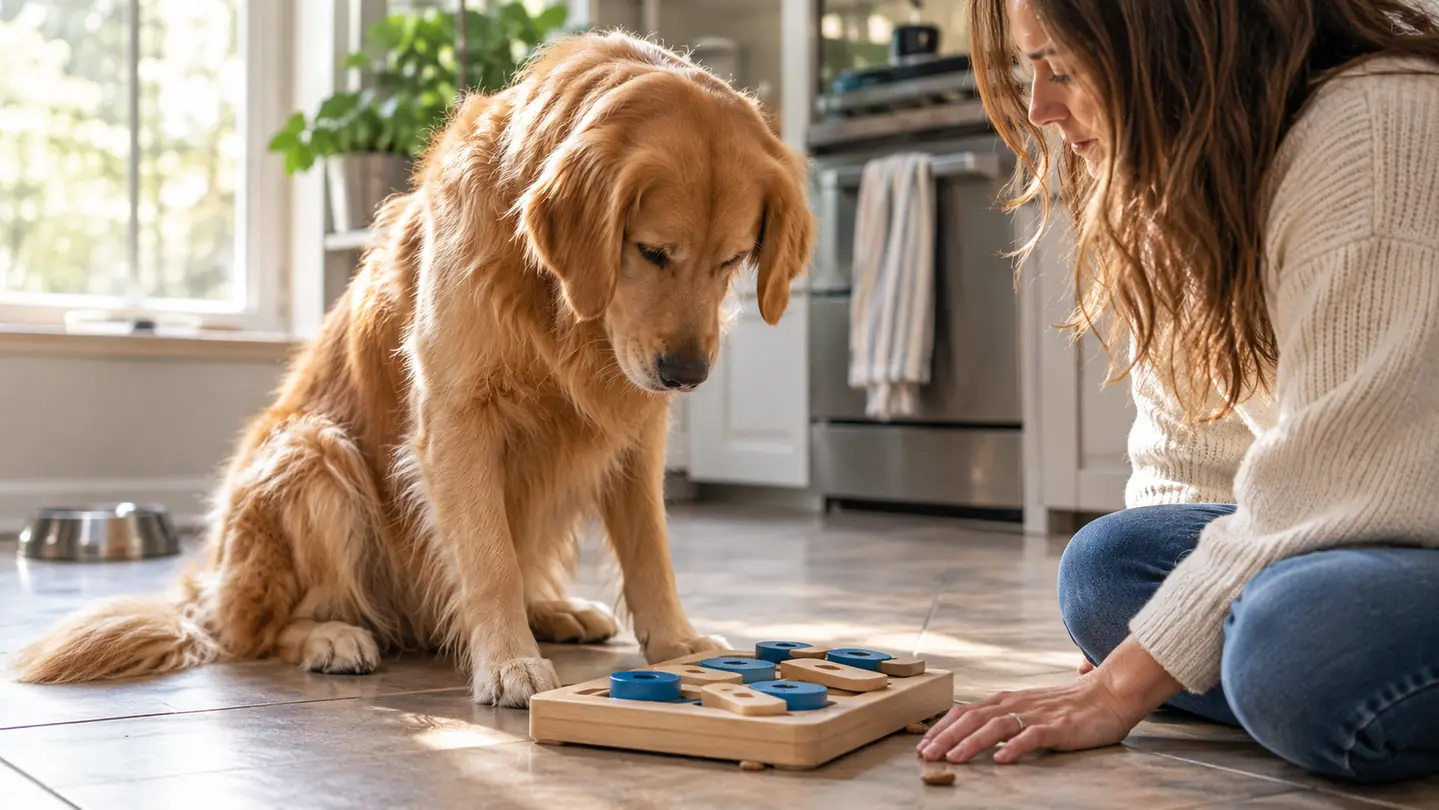
The first time I put a treat puzzle down for a dog, I did it wrong. I set it on the tile, stepped back, and waited for the dog to be delighted. Pepper looked at it, looked at me, and pawed at the nearest lid until it flipped. Then she barked at me like I had hidden her breakfast on purpose. That was two years ago with the Outward Hound Nina Ottosson Dog Brick. Pepper is six now, a 42 pound cattle dog mix who gets bored fast and shreds anything flimsy. The puzzle survived. My approach needed work.
If you have a dog that needs a job, a puzzle toy can fill a small gap in the day. It is not a replacement for a walk, and it is not a cure for anything. It is a way to make a dog use its nose and its brain for ten minutes while you keep one eye on the room. The Dog Brick is Level 2 Intermediate. That is not where I start a dog that has never worked for food. Here is the sequence I use now, with Pepper and with the guest dogs that come through my house in Tehachapi.
Start With One Layer, Not All Three
The Outward Hound Nina Ottosson Dog Brick has sliders, flip lids, and lift out bone pieces. That is three jobs in one puzzle. A beginner only needs one job at a time.
Amazon See the Dog Brick on Amazon →What the Dog Brick Asks of a Dog
The listing describes three actions: pick up the bone pieces, flip open the lids, and move the sliders to uncover treats. The puzzle is 12.75 inches long and weighs 8.82 ounces. It is light enough to carry from the closet to the kitchen with one hand, and it sits flat on the tile. The listing calls it medium breed size, which fits Pepper at 42 pounds and most of the guest dogs I take. It is not water resistant, so I wipe it with a damp cloth instead of rinsing it at the sink.
That sounds simple to a person. It is not simple to a dog that has never had to move a piece of anything to get a piece of food. A dog that eats from a bowl gets food for standing there. A puzzle asks the dog to notice a lid, try a paw, try a nose, and try again when the first try does not work. Some dogs love that. Some dogs shut down if the first try is too hard. The difference is usually the setup, not the dog.
Step 1: Pick a Quiet Moment and One Dog
Pick a time when the house is quiet and you can sit on the floor. For me that is mid morning on a rainy day or a very hot day, after Pepper has had a walk and before the guest dogs get their afternoon nap. Do not start at dinner time with three dogs circling the kitchen. Do not start right before you leave the house. A puzzle is a conversation between you and one dog, and the dog can feel your hurry.
Give every dog its own spot. In my house that means one dog in the kitchen, one in the hall, and one on the covered back porch if the weather is mild. Food toys are always supervised here, and no dog is left alone with any toy. That is not because the puzzle is dangerous. It is because dogs guard food, and a guest dog will steal from a slower dog if given the chance. One dog per toy, always.
Start with a dog that is already a little tired but not exhausted. A dog that has been on a long walk may ignore the puzzle and go to sleep. A dog that has been cooped up all morning may hit the puzzle too hard and try to chew it. The sweet spot is a dog that has had a normal walk and is looking for something to do.
Step 2: Set the Puzzle to Its Easiest Version
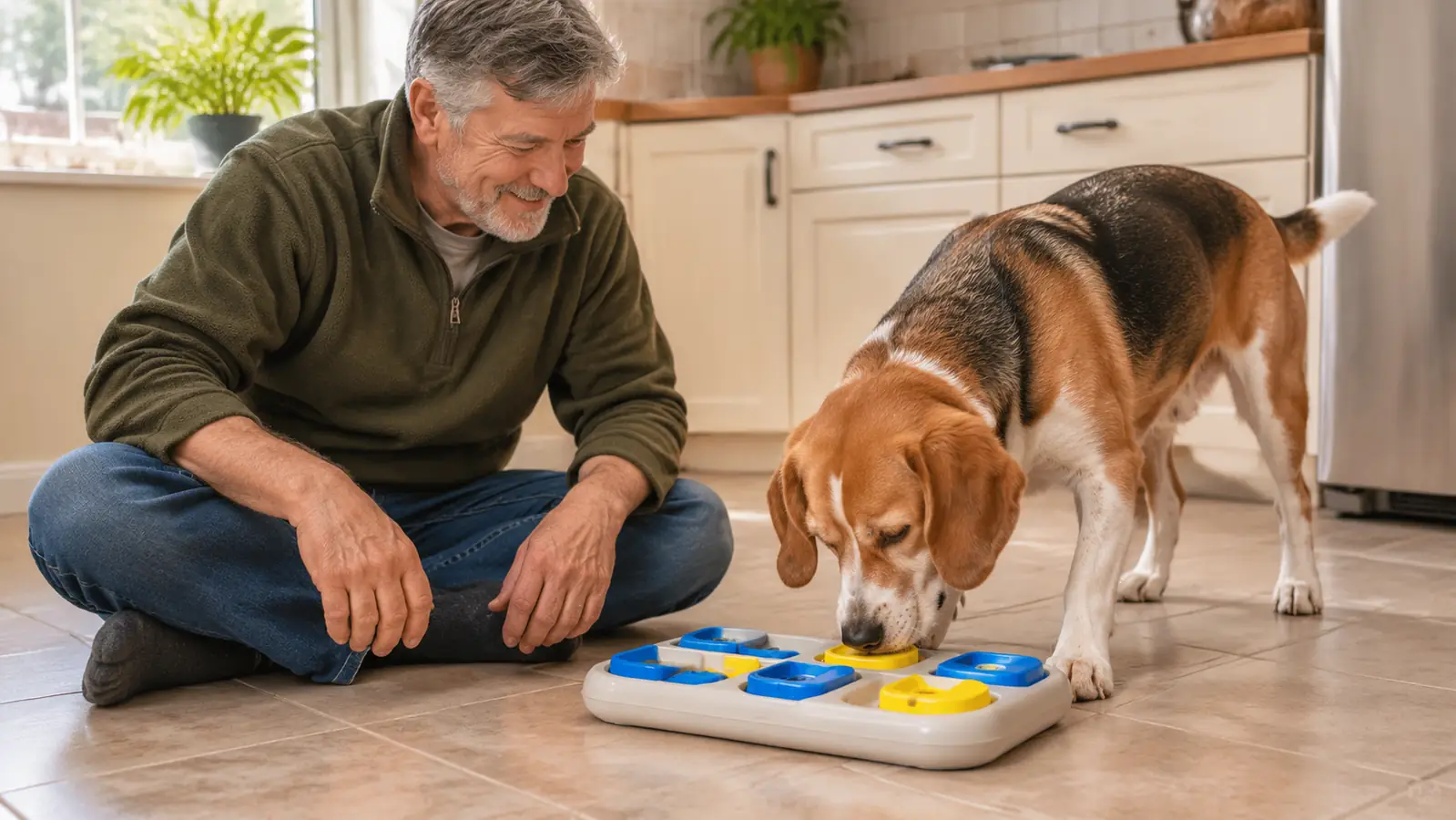
Set the puzzle to its easiest version. Put the bone pieces aside and leave the lids open. Put a few pieces of kibble in the open slider tracks and let the dog see you do it. The first session is not a test. It is a demonstration that food can be found on this thing. I use Pepper's regular kibble, not a handful of high value treats, because I want the puzzle to be part of a meal, not a jackpot that makes her wild.
Set the puzzle on a surface that does not slide. The tile kitchen floor is fine if the dog is calm. A towel under the puzzle helps with a dog that pushes hard. Let the dog sniff the puzzle before you ask for anything. Do not tap the sliders or put a treat on top and then move it around. Let the dog find the first piece with its nose. That first find is the whole point of the session.
Keep the first session under five minutes. If the dog finds the kibble in the open tracks, stop and put the puzzle away. One win is better than ten minutes of confusion. If the dog walks away, do not follow with the puzzle. Put it up and try again the next day. A puzzle that becomes a chore for the dog is a puzzle that stays in the closet.
Step 3: Let the Dog Work, but Stack the Wins
Let the dog work, but stack the wins. When Pepper first started, she pawed at the lids because that is what she does with anything new. Pawing is fine. Digging is fine. Nosing is better. I did not solve the puzzle for her, but I did make the first step easier by leaving one slider partly open. The dog needs to feel the cause and effect, not watch me do the work.
Pepper needed three sessions to stop pawing at the brick and two weeks before she was solving it fast. That is my normal timeline now. I plan for two weeks of short sessions. If a dog solves it in two days, good. If a dog is still pawing at the same spot after a week, I go back to open sliders and stay there. There is no prize for rushing a dog through a puzzle.
Watch for the moment the dog gets tight. The ears go back, the tail stops, the dog starts to bite at the puzzle instead of nosing it. That is not a dog that needs encouragement. That is a dog that needs the puzzle put away. I end every session on a find, even if I have to set up a small easy find at the end. The last thing the dog remembers should be success.
Pepper needed three sessions to stop pawing at the brick and two weeks before she was solving it fast. That is the pace I plan for with every dog now.
Step 4: Add the Lids and Bone Pieces One at a Time
Once the dog is moving the sliders with its nose and finding the kibble fast, add one lid. Not all the lids. One. Put the lid over a track the dog already knows. Let the dog flip it open. The flip is a new skill, and it is the part that makes the puzzle feel like a puzzle. If the dog chews the lid, take it away and go back to open sliders for a few days.
After the dog can flip one lid, add the bone pieces. These are the lift out pieces that sit over the tracks. The dog has to pick them up or push them aside to get to the food. This is the part that made Pepper slow down. She could flip a lid with her nose, but the bone pieces needed a different move. That is the point of the three in one design. It asks for more than one kind of problem solving.
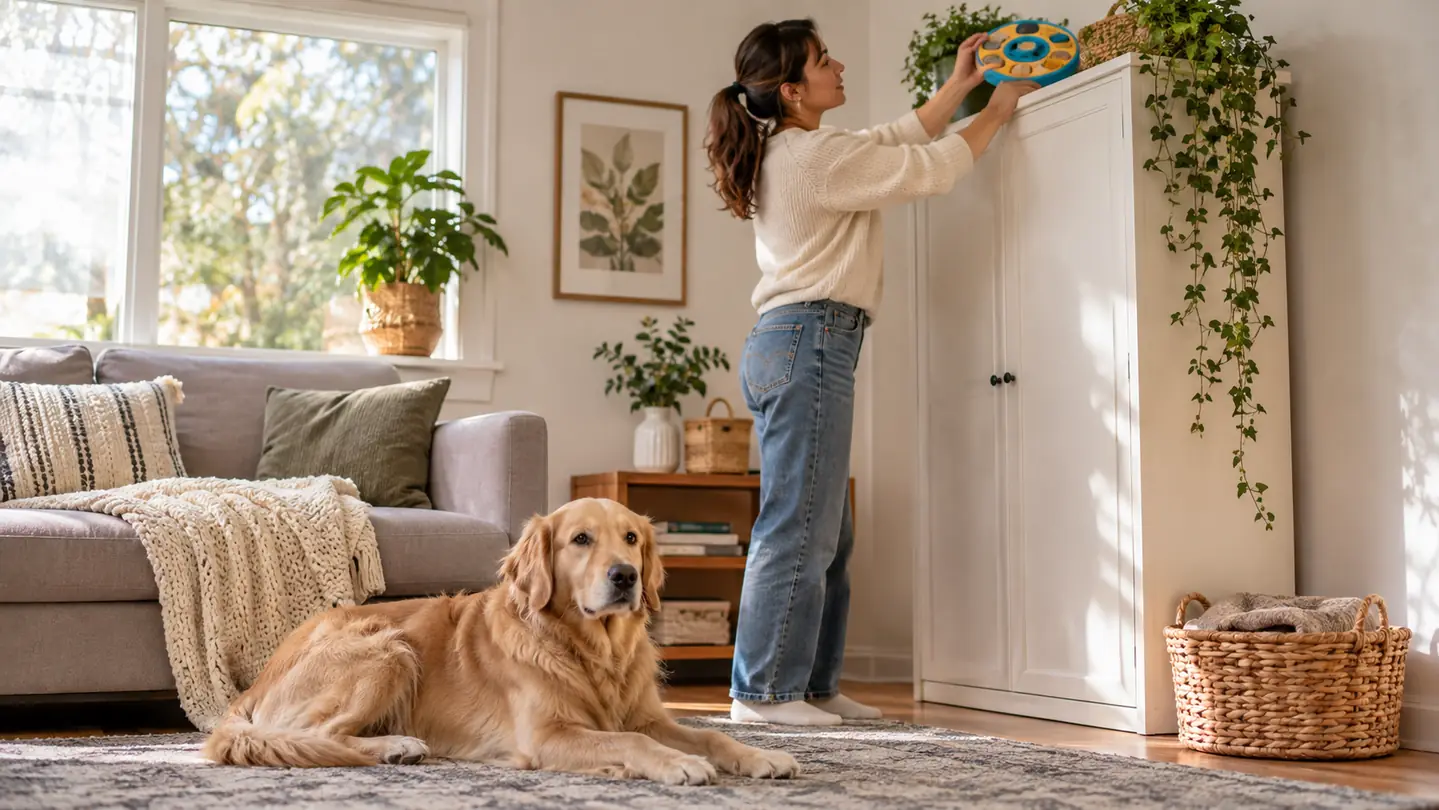
This is also the stage where I remember that the Dog Brick is not a chew toy. The lids, the sliders, and the bone pieces are not for chewing. If a dog starts to gnaw on a piece, the session is over. That is why the puzzle lives on the hall closet top shelf and comes out only when I am sitting beside it. I bought the Outward Hound Dog Tornado the same month as the Brick. Pepper flipped it and chewed a layer, and I gave it away after about a month. The Brick only survived because I did not leave it down.
Step 5: Make It a Short Routine and Put It Away
Make it a short routine. The Dog Brick comes out mid morning, one dog at a time, for about ten minutes. That is the session length that works here. It is long enough to settle a busy dog and short enough that the dog does not get frustrated. After the session, I wipe the puzzle with a damp cloth and put it back on the shelf. I do not rinse it, because the listing says it is not water resistant.
Use the puzzle as part of the day, not as the whole day. Pepper still gets both walks. The guest dogs still go outside. The puzzle fills the gap when the weather is bad or when I need a dog to settle while I make lunch. A dog that has had no exercise and no training will not be fixed by a puzzle. A dog that has had a walk and a little attention will often take a nap after ten minutes of nose work. That is what I am buying.
Rotate it with other food toys so it stays interesting. The Dog Brick is the mid morning brain game here. The snuffle mat is for breakfast for a fast eater. The LickiMat is for bath time and nail trims, and for a nervous guest dog on its first evening. The KONG Extreme is Pepper's 7pm chew. The Toppl is a frozen afternoon treat on the porch. None of them replace a walk, and none of them are left down with a dog that might chew them.
What Else Helps
Exercise first. A puzzle is not a substitute for a walk, and it is not a substitute for training. The dogs that do best with the Dog Brick here are the ones that have already been outside and have already had a little time with a person. If you are short on time, a ten minute walk and a five minute puzzle will do more than a thirty minute puzzle alone.
Feed one dog at a time and pick the puzzle up when the food is gone. A puzzle left on the floor becomes a chew toy, and a dog that chews the pieces can swallow something it should not. I learned that with the Tornado, and I did not need to learn it twice. The Brick is a supervised toy in this house. It is not a babysitter.
Keep the treats simple. I use kibble, plain yogurt, canned pumpkin, and peanut butter with no xylitol. For the Dog Brick I mostly use kibble, because the puzzle is about the hunt, not the food. Save the wet stuff for the LickiMat or the Toppl. A dry puzzle stays cleaner and is easier to wipe down between sessions.
Know what the puzzle is for. It is for a dog that needs a job for ten minutes. It is not a cure for a behaviour problem, and it is not a replacement for a vet or a trainer if a dog is struggling. If a dog is too anxious to eat, or too sore to get comfortable on the floor, a puzzle is not the answer that day. I put the puzzle away and call our vet when something is off. A toy is a toy.
A Ten Minute Job for a Dog That Needs One
The Outward Hound Dog Brick is the puzzle I reach for on rainy mornings and hot afternoons. Start with one layer, keep the sessions short, and put it away when the dog is done.
Amazon Check Availability on Amazon →